

How Far Will AI Transform Google Analytics?
The “Next Form of Analysis” Revealed by Three Emerging AI Capabilities
(Original Japanese article by Nao Kobayashi, Ayudante. English adaptation by Masaki Kuroshima.)
This article introduces three AI capabilities related to Google Analytics and generative AI.
Whether you once stepped away from GA because it felt complex, or you actively use it as an advanced practitioner, this article aims to organize how generative AI is beginning to reshape the way Google Analytics is used.
The Ayudante GMP team highlights three AI capabilities worth attention:
- Analytics Advisor
- Google Analytics MCP Server
- Gemini in BigQuery
GA4 (Google Analytics 4) allows data export to BigQuery—even in the free version—making it possible to use exported GA data as a foundation for generative AI-driven analysis.
As of January 2026, AI-powered GA analysis is still at an early stage of evolution.
In addition to the features discussed here, Google has been releasing machine learning–based capabilities such as:
- Cross-channel budgeting
- Advertising performance analysis
- Forecasting the impact of budget increases
However, rather than asking which feature is superior, it is more important to determine how each capability should be used depending on business objectives and analytical maturity.
1. Analytics Advisor
For marketers who want to quickly experience GA × AI
Analytics Advisor is a generative AI feature embedded directly within the Google Analytics interface.
It functions like a Gemini-style conversational prompt inside GA.
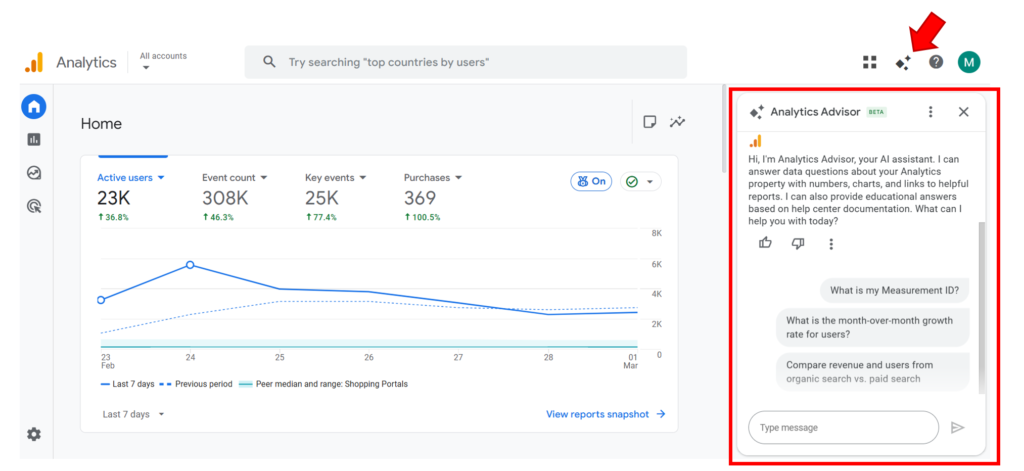
Key Characteristics
- Immediately accessible within GA
- No additional implementation required
- No advanced technical knowledge necessary
- Questions and responses are not used for external model training
- Relatively low hallucination risk
Scope of Analysis
The scope is limited to the GA property currently open in the UI.
Even if linked, Search Console data is not included.
The analysis is confined to GA data within that property.
What It Can Do
- Answer analytical questions in natural language
- Provide links to relevant GA reports
- Suggest event configuration improvements
- Offer optimization recommendations based on best practices
As of January 2026:
- It does not analyze raw exported GA data.
- Advanced segment-based analysis appears limited.
- It cannot inspect website tags or Google Tag Manager configurations.
Future enhancements may expand segmentation capabilities and configuration guidance.
For more details, please refer to the official Google page:
▽ Analytics Advisor (Beta)
https://support.google.com/analytics/answer/16675569?hl=en
2. Google Analytics MCP Server
For teams with development capabilities seeking automation and custom AI agents
The Google Analytics MCP (Model Context Protocol) Server, released at the end of last year, provides a standardized method for connecting GA data with external generative AI systems.
Unlike Analytics Advisor, implementation requires:
- Cloud environment setup
- API knowledge
- Technical development skills
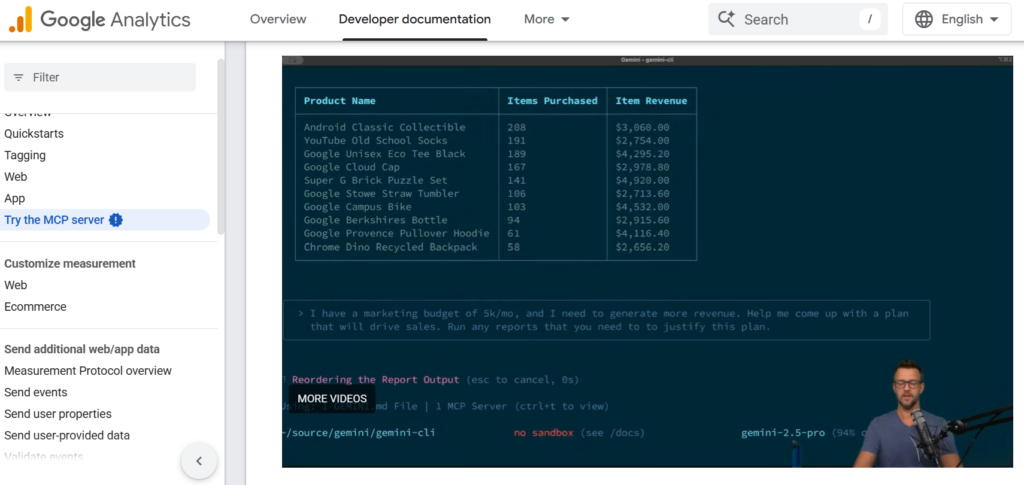
Source: https://developers.google.com/analytics/devguides/MCP
Key Characteristics
It supports integration with AI systems beyond Gemini, such as:
- Claude
- Cursor
- Gemini CLI
- Other MCP-compatible AI agents
Depending on the AI system used, it enables:
- Automated chart generation
- Report page creation
- Custom AI agent development
- Integration of GA data with CRM, purchase data, or public statistics
- Context-aware analysis of website content
Scope of Analysis
Data access is limited to GA APIs (Data API and Admin API).
As of January 2026, API functionality has certain limitations—for example, segment capabilities are restricted.
MCP is an open-source protocol designed to standardize AI-tool integration, and ecosystem expansion is expected.
For more details, please refer to the official Google page:
▽ Try the Google Analytics MCP server
https://developers.google.com/analytics/devguides/MCP
3. Gemini in BigQuery
For organizations serious about long-term and advanced analytics
Gemini in BigQuery is a generative AI capability within BigQuery—not a GA feature.
Since GA4 allows data export to BigQuery (including the free version), exported GA data can serve as a foundation for advanced analysis.
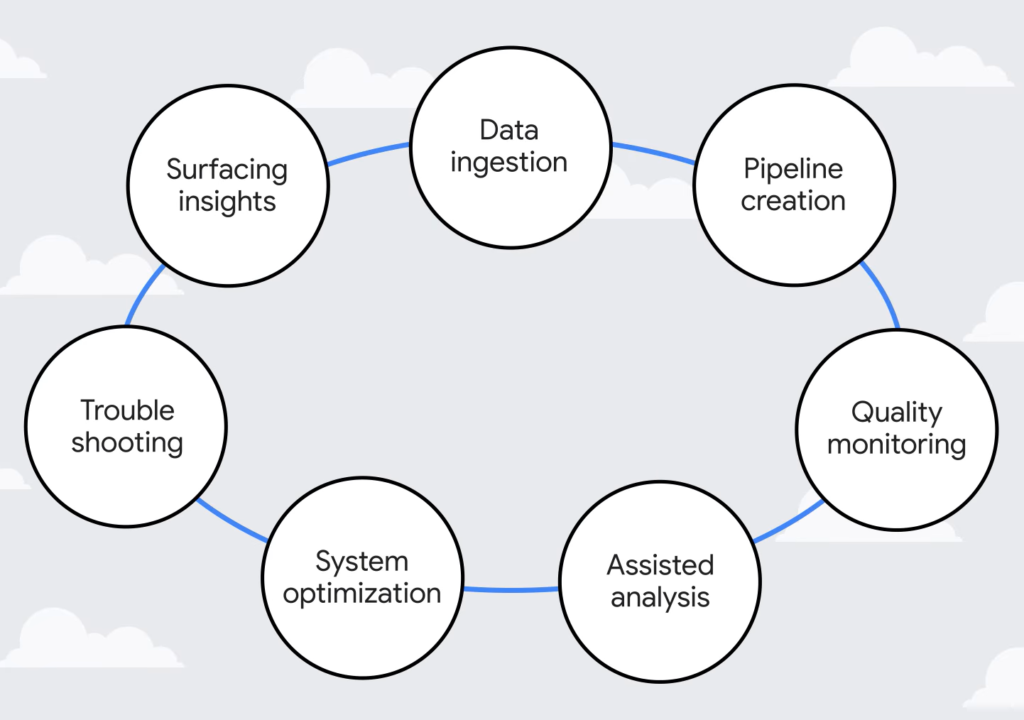
Source: https://youtu.be/-MWIHAH4cbA?si=I6g3F2d9jhAG6hpS
Key Characteristics
Data exported to BigQuery:
- Is not bound by GA data retention limits
- Is not constrained by GA API functional limitations
- Supports long-term, granular analysis
Gemini in BigQuery can:
- Generate SQL queries
- Suggest Python code
- Propose analytical approaches
- Support statistical and machine learning analysis
- Provide diverse visualization capabilities
This environment offers the most sustainable and extensible analytical infrastructure among the three approaches.
Important Consideration
Executing queries in BigQuery incurs usage costs under Google Cloud Platform. Organizations should consider this when designing their analytics architecture.
For more details, please refer to the official Google page:
▽ Gemini in BigQuery overview
https://docs.cloud.google.com/bigquery/docs/gemini-overview
The Most Important Point When Using GA and Generative AI
No matter how advanced generative AI becomes, meaningful business analysis is impossible without properly structured data.
If:
- UTM parameters are inconsistent
- Ecommerce tracking is not configured
- Key events are not properly defined
- Membership or CRM data is not integrated
then accurate insights cannot be achieved.
Garbage in, garbage out.
As of January 2026, AI-powered GA analysis is still at the beginning of its evolution. The future will not depend on a single tool, but on selecting the right AI capability for the right analytical purpose.
More importantly, as AI advances, data governance, tagging accuracy, and measurement design become even more critical.
At Ayudante, we strongly emphasize the importance of structured data architecture as the foundation for sustainable AI-driven analysis.