

Rethinking Marketing Measurement in the AI Era: Highlights from the 2026 ANA Measurement & Analytics Conference in Chicago (Part 1)

From September 28 to 30, 2026, I attended the ANA Measurement & Analytics Conference in Chicago. This was my second year at the event. Like last year, the conference was held in Chicago, but this time at a different venue, the Radisson Blu Aqua Hotel. Organized by the Association of National Advertisers (ANA), it brought together marketing, analytics, media, technology, and finance leaders from brands, platforms, agencies, and measurement providers.
AI appeared throughout the agenda, but many of the discussions ultimately returned to a more basic question: what role does measurement play in helping marketers make better decisions? In this two-part series, I’ll share the sessions that stood out most. Part 1 covers the conference overview and sessions from Google and Meta.
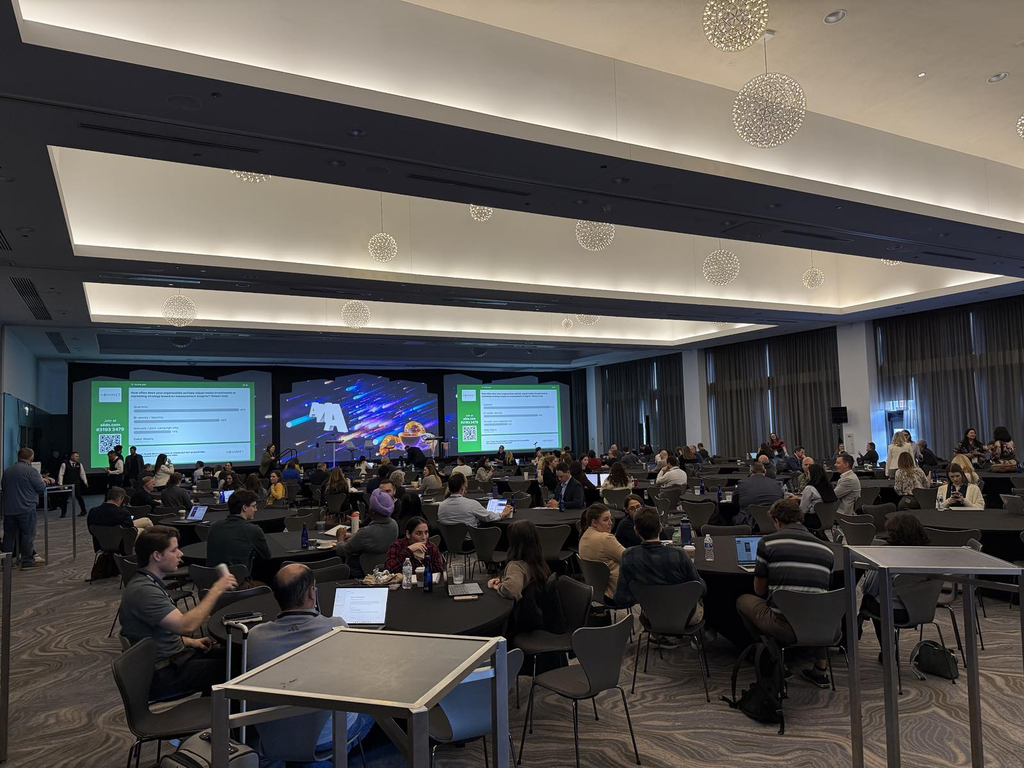
(The main conference hall at the 2026 ANA Measurement & Analytics Conference in Chicago.)
Overall Summary: Measurement for Better Decisions
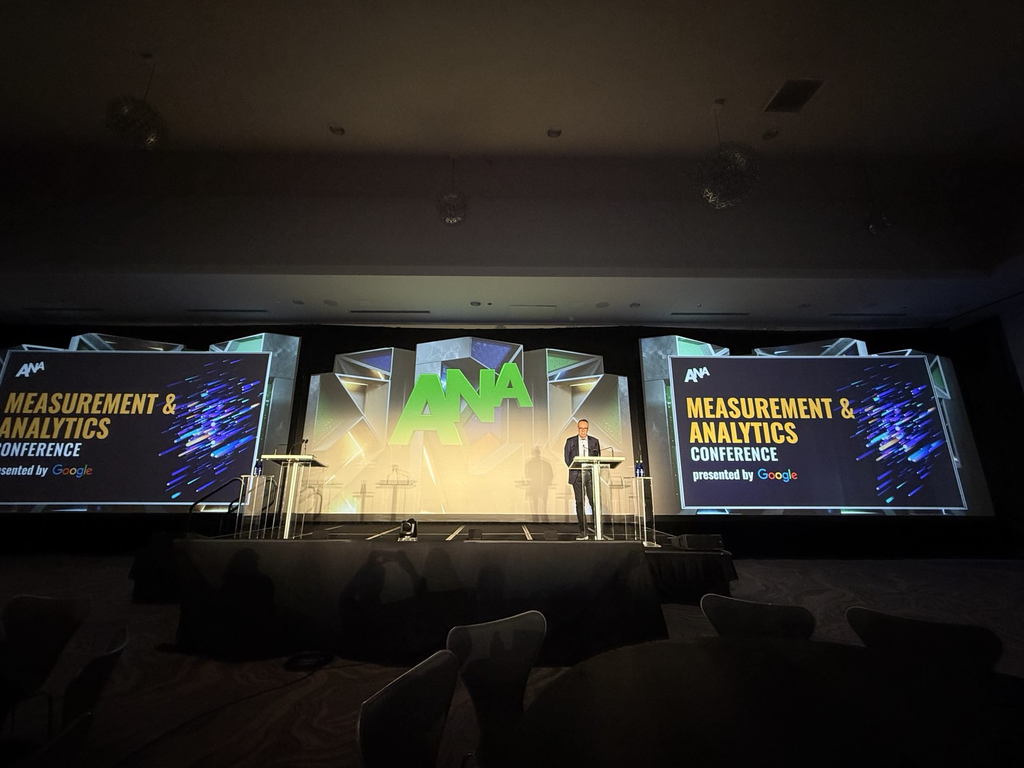
(ANA Chief Executive Officer Bob Liodice opens the main conference program.)
The main program opened with Bob Liodice, CEO of the ANA, who framed the entire conference around one idea:
“This is one of my favorite conferences, and it is because it is on the subject about how we make better decisions.“
For Liodice, measurement is not an end in itself. It is the first link in a chain: better measurement leads to better decisions, and better decisions lead to business growth.
He then pointed to a paradox many marketing teams will recognize. According to the figures he shared, marketers now use roughly 230% more data than they did five or six years ago, yet only 47% feel the quality of their marketing data allows them to make the most effective decisions possible. More data, in other words, has not automatically produced more confidence.
Part of the answer, he suggested, is to start with the business question. In a video shown during the session, Delta Air Lines’ analytics team described joining campaign kickoff conversations from the start, rather than being asked ten days after launch whether a campaign worked. Liodice closed by noting that CMOs increasingly understand that “measurement is the pathway to better decisions and better growth overall.”
Taken together, the opening reframed the challenge for the rest of the conference. For most organizations, the issue is no longer collecting enough data. It is turning the data they already have into evidence that teams trust enough to act on.
Session Highlight①: Google — If You Are Spending, You Need to Be Testing
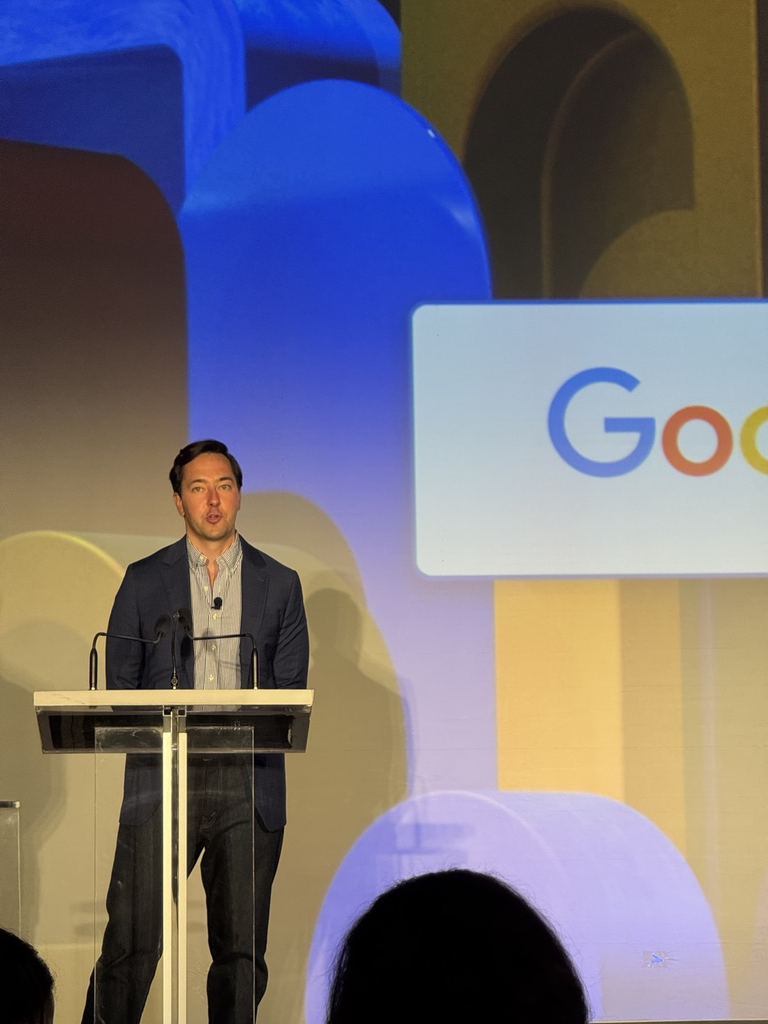
(Google Analytical Lead John Thompson.)
John Thompson, Analytical Lead at Google, took a deliberately practical approach. Rather than presenting an advanced framework, he spoke to marketers who feel overwhelmed by measurement. Teams now face AI, marketing mix modeling (MMM), incrementality testing, privacy changes, and a steady stream of new channels, and many lack the time or data science resources to do everything properly. In that environment, it is tempting to wait until the perfect setup is in place. Thompson disagreed:
“I firmly believe that perfection is the enemy of progress in today’s world, especially in measurement.“
He also observed that measurement attention is unevenly spread. Performance channels get tested the most, because testing is built into the platforms, while brand investment is often measured far less than it should be. His point was not to cut brand spending, but to measure it as seriously as performance. That led to the one line he wanted the audience to remember:
“If you are spending, you need to be testing.“
One of the most practical ideas in the session was the cost of inaction. Measurement is usually discussed as a cost to justify. Thompson asked the opposite question: what does not measuring cost? One slide cited research from Forbes showing that marketers waste an average of 26% of their budgets on unproductive strategies and ineffective channels. His point was that poor or insufficient measurement has a cost of its own: budget keeps flowing toward ineffective activity, opportunities to reallocate investment are missed, and potential incremental revenue is left on the table.
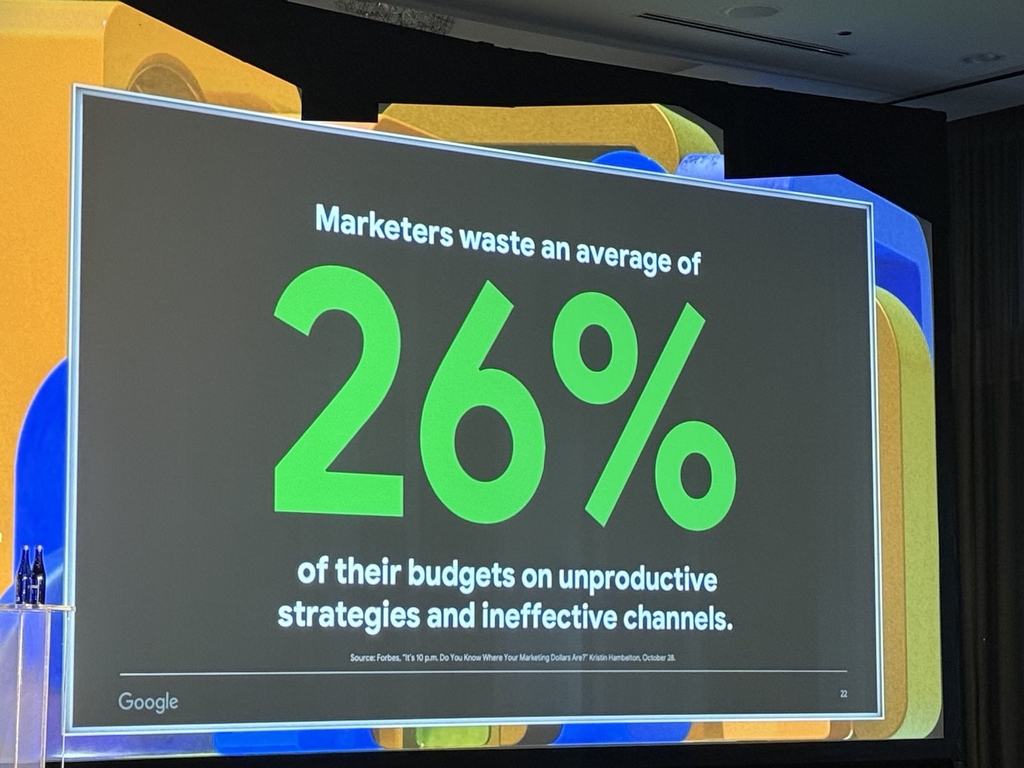
[Google highlighted the potential cost of insufficient measurement, citing research that marketers waste an average of 26% of their budgets on unproductive strategies and ineffective channels.]
As a starting point, he recommended experimentation. Traditional MMM can require substantial historical data and analytical investment, while experiments can be run on most channels, and many ad platforms now build testing directly into their tools. Not every test will produce a positive result, but even negative or inconclusive results can generate useful learning for the next decision.
The takeaway was simple: start with a business question, start testing, learn, and repeat. Like the Delta example in the opening, Google’s session suggested that measurement works best when it is designed into marketing activity from the beginning, rather than added after the campaign ends.
Session Highlight②: Meta — From Attribution to Incrementality
(Meta Director, Marketing Science Diana Lucas.)
If Google’s message was to start testing, Diana Lucas, Director of Marketing Science at Meta, addressed the next question: how should marketers evaluate impact when attributed conversions don’t necessarily reflect what marketing caused? She opened with a phrase that captured a tension heard throughout the conference:
“Decision speed has outrun evidence speed.“
AI-driven advertising systems now make thousands of choices every week on an advertiser’s behalf, shifting budgets, rotating creative, and selecting audiences. Yet the evidence on whether those choices are working often still arrives on a human calendar, in quarterly reviews. Left alone, Lucas warned, the systems that spend the budget end up being the only witness to whether it worked.
To close that gap, she explained the difference between attribution and incrementality. Attribution gives credit for a conversion to the ads or touchpoints a customer interacted with, often the last click. Incrementality asks a different question: what happened because of the advertising? It compares people who had the opportunity to see an ad (the exposed group) with a similar group who did not (the control group). In her example, the exposed group produced 4,600 outcomes, while the control group, which never saw the ad, still produced 3,500. Attribution might credit all 4,600 to marketing, but since 3,500 would likely have happened anyway, the incremental effect was roughly 1,100. That, she said, is the number a CFO is really asking about.
Lucas did not argue that experiments should replace everything else. Each method plays a different role: attribution is timely, MMM provides a broad view across channels, and experiments establish causality. What connects them is calibration, using experiment results to correct the other models. If a lift test shows a channel drove 150 incremental conversions while attribution credits it with 100, you don’t throw away the attribution model. You adjust it, and for the first time you know the size of the error you’ve been carrying.
She closed with a four-stage maturity model: Reporting → Testing → Calibrating → Compounding. Most organizations, she said, sit between the first two stages, running experiments occasionally but losing the learnings in slide decks and individual memories. The strongest organizations retain what they learn and use it to recalibrate models and budgets on a regular cycle. As she put it, “The distance is not technological; it is operating discipline.“
For me, this was the clearest expression of a theme that ran through the conference: measurement as an ongoing decision system, not a periodic report.
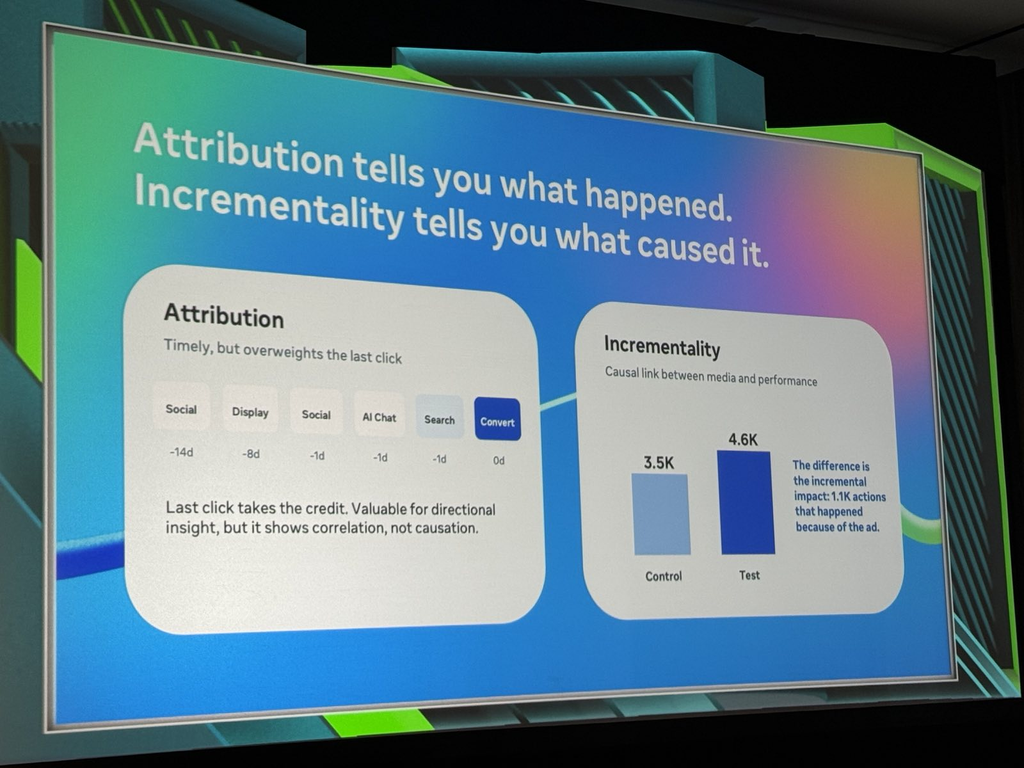
(Meta illustrated the difference between attribution and incrementality: attribution shows what happened, while incrementality estimates what advertising caused.)
Google and Meta showed why measurement needs to move beyond campaign reporting. In Part 2, I’ll look at the foundation required to make faster, AI-supported measurement trustworthy, through sessions from Lowe’s and CVS Health, along with what the exhibition floor revealed about the modern measurement stack.
🔜 Continue to Part 2 → [link to Part 2]