

Building Trusted Measurement for the AI Era: Highlights from the 2026 ANA Measurement & Analytics Conference in Chicago (Part 2)
🔙 Missed the beginning? Start with Part 1 → [link to Part 1]
In Part 1, I covered the ANA’s framing of measurement as the pathway to better decisions, followed by sessions from Google and Meta. Google argued that complexity is no excuse for inaction: if you are spending, you need to be testing. Meta showed that attributed conversions are not the same as incremental impact, and that experiments should be used to calibrate other methods. Both sessions pointed to the same next question. If measurement and AI are going to support faster decisions, can organizations trust the data and definitions underneath them? Two sessions, from Lowe’s and CVS Health, addressed that question most directly.
Session Highlight③: Lowe’s — Trusted Data Before AI
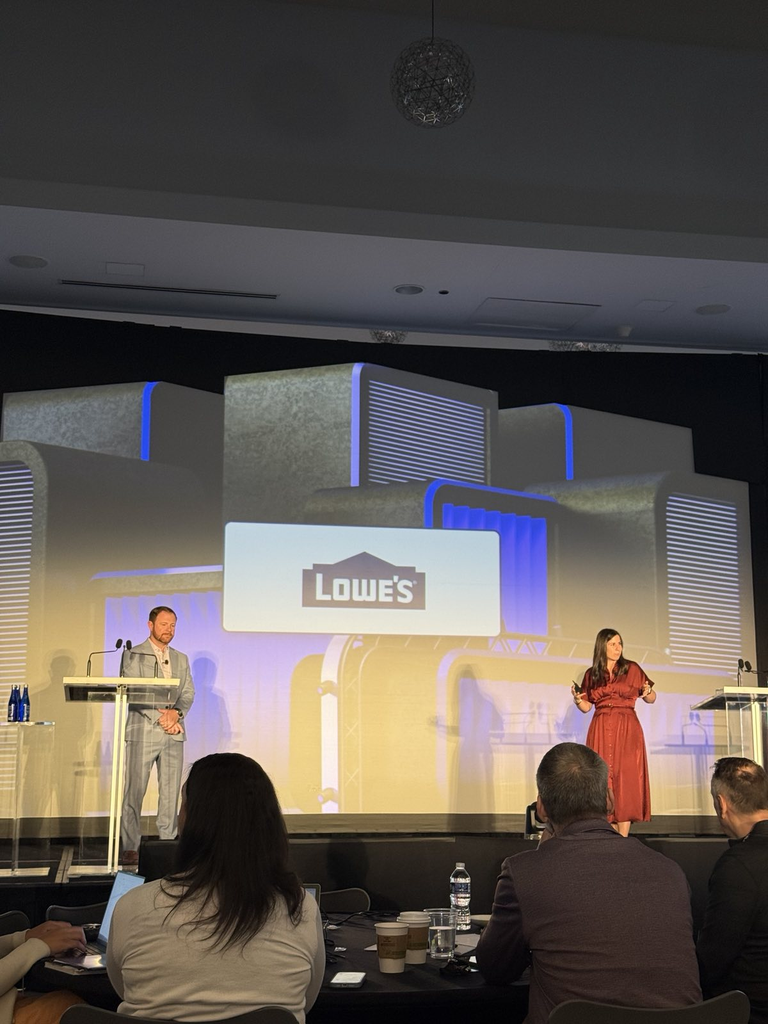
(From left: Lowe’s Vice President, Applied AI, Data & Analytics Scott Canney, and Lowe’s Media Network Senior Director, Measurement Strategy & Analytics Mimi Munkwitz.)
Scott Canney, Vice President, Applied AI, Data & Analytics at Lowe’s, presented with Mimi Munkwitz, Senior Director, Measurement Strategy & Analytics at Lowe’s Media Network. Munkwitz started with how customer behavior has changed. During COVID, she recalled, many teams debated whether shoppers would return to stores or stay online. Customers settled the question themselves:
“They don’t pick a channel.“
A home improvement customer might be inspired on Instagram, order flooring samples online, visit a store, and finally buy in store. Those touchpoints, as Canney put it, naturally create fragmented data. Last-touch attribution sees only the final purchase; connecting more of those signals is what reveals what actually drove the outcome.
Lowe’s does not rely on one method to make sense of this. Last-touch attribution supports in-flight optimization, such as testing which message performs better mid-campaign. Incrementality shows what marketing actually caused. MMM guides budget allocation and scenario planning. The key, Munkwitz stressed, is to start from the business objective and then choose the method. Her team uses a phrase coined by a colleague: “What’s the question behind the question?” Instead of answering only the literal request, analysts first identify the decision the business is actually trying to make.
The most important part of the session was the foundation underneath. Using LookML and Google Cloud, Lowe’s is building an enterprise semantic layer. In simple terms, a semantic layer is a governed place where key business metrics and their definitions are standardized, so that teams and AI applications can interpret them consistently. Canney described it as bringing scattered metrics into a single contextual layer certified and trusted by the business, supported by a data dictionary. Business owners hold the keys and decide who gets access.
Only then does AI come in. With an LLM working on top of that trusted layer, analysis that once took days or weeks of data gathering can surface much faster. Lowe’s still keeps people in the loop: the team’s time shifts from gathering data to validating results and applying decision science.
The takeaway was clear. Lowe’s is not placing AI directly on top of uncontrolled raw data. Trusted definitions come first, and AI then shortens the path from question to decision, with people still validating the answer and making the call.
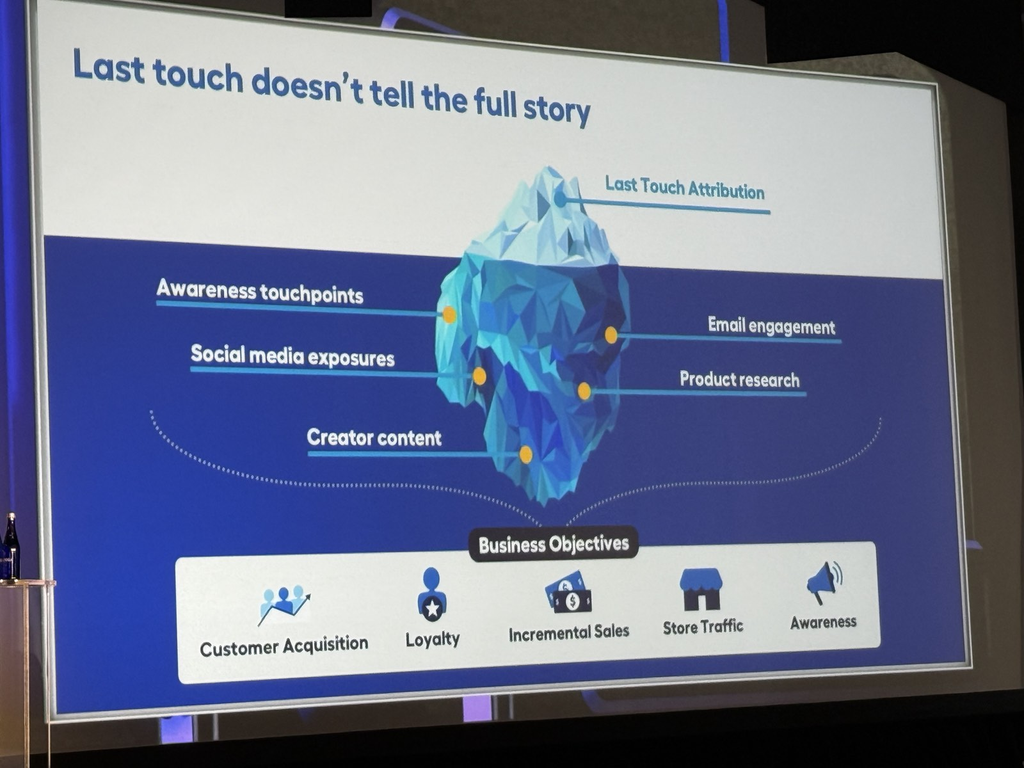
(Lowe’s used the iceberg as a visual reminder that last-touch attribution captures only part of the customer journey. Similar iceberg imagery appeared in several sessions across the conference.)
Session Highlight④: CVS Health — The Outcome of Measurement Is Confidence
(CVS Health AVP of Digital, Data, Analytics, and Technology Francis Suo.)
If one session brought the conference’s themes together, it was this one. Francis Suo, AVP of Digital, Data, Analytics, and Technology at CVS Health, began with a frustration many measurement teams share: the team keeps raising its standards and innovating, yet business partners’ confidence in measurement barely moves. The lesson Suo drew was that the real outcome of measurement is not the number itself, but the confidence to act on it.
One example illustrated the problem well. Three teams ran different tactics against a similar group of customers, and each showed statistically significant incremental results. Yet finance saw the value of those same customers declining year over year. When CVS Health investigated, it found that the teams were using different metric definitions, sometimes different data tables, overlapping experiments that contaminated each other, and different baselines. Each analysis was technically defensible, but together they did not add up to a coherent picture for the enterprise.
From lessons like this, CVS Health built a five-layer framework for trust, in which each layer builds on the one below:
- Data: Is the underlying data reliable, integrated, and monitored for quality?
- Semantics: Are teams using the same definitions for KPIs, conversions, and customers?
- Evidence: What does the method actually prove, and is the result causal and durable?
- Decision governance: Who makes the decision, and are marketing, analytics, finance, and the business aligned?
- People: Who applies judgment, asks the right questions, and takes responsibility for the final call?
Suo then turned to AI, with a measured view: “It can help when the trust is there. It cannot create trust.” AI can automate data quality monitoring, connect evidence across past tests, and make results easier to communicate. But framing the business problem, weighing trade-offs, and accountability for the final decision remain human. The session’s closing line summed up the point:
“AI is a multiplier. It multiplies trust. It also multiplies the flaws.“
The implication is practical rather than alarming. A strong measurement foundation combined with AI leads to faster, more confident decisions. A weak foundation combined with AI simply scales flawed assumptions faster.
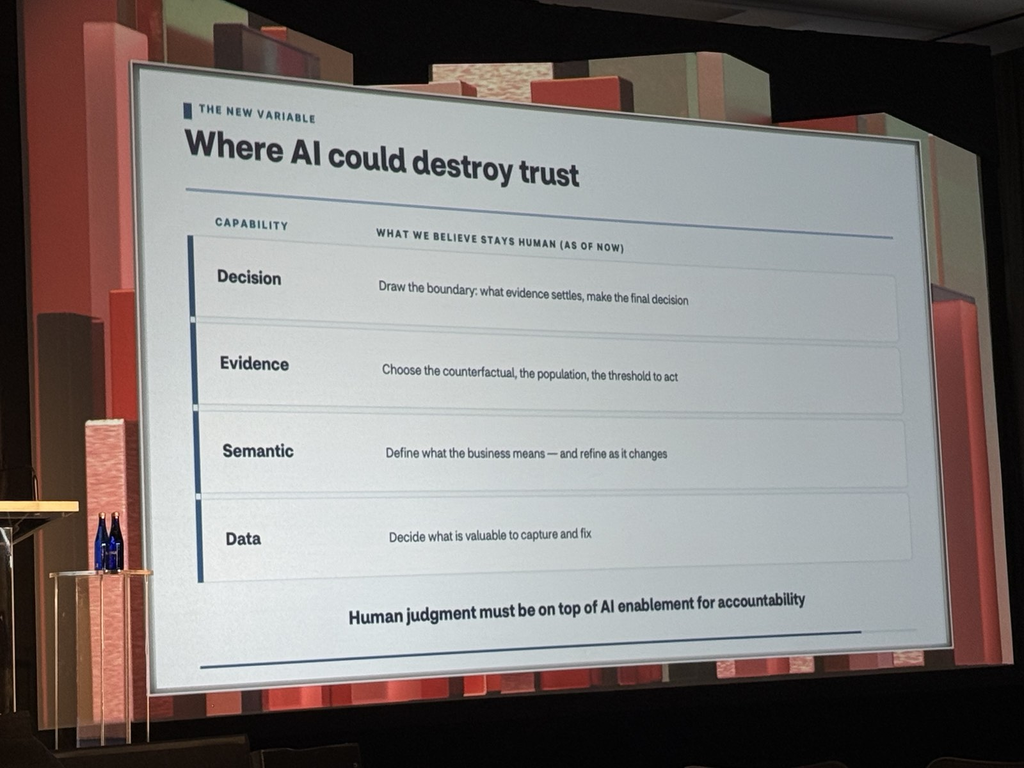
(CVS Health showed how trust can break down across data, semantics, evidence, and decision-making, with human judgment remaining essential.)
Exhibition Highlight: Building the Modern Measurement Stack
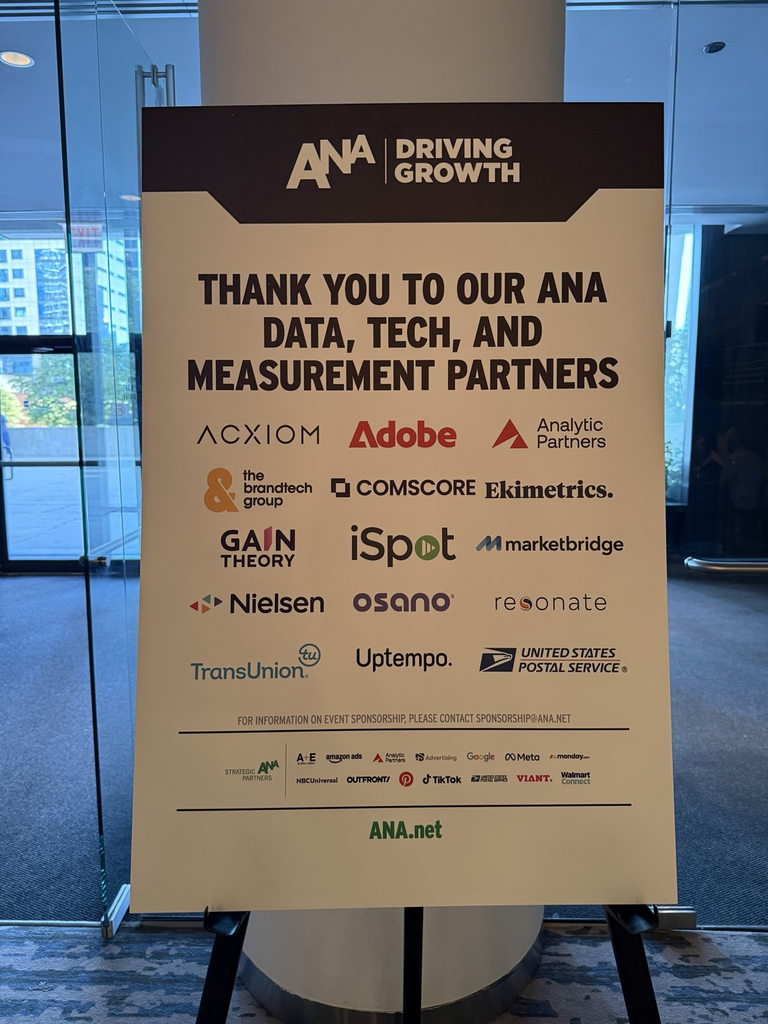
(ANA Data, Tech, and Measurement Partners represented across the conference.)
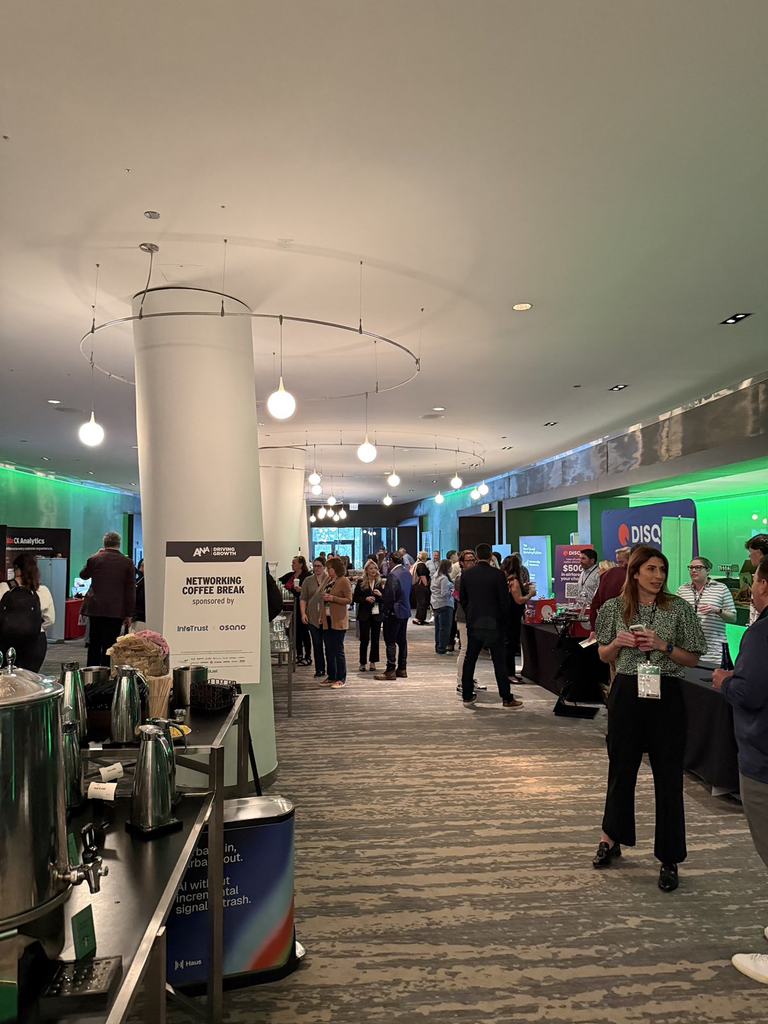
(The exhibition area outside the main conference hall, where 10+ sponsors and exhibitors showcased measurement, data, media, and analytics solutions.)
Around 10+ sponsors and exhibitors set up booths in the foyer outside the main hall. Rather than any single company, what stood out to me was what the floor said as a whole: the measurement market is expanding well beyond simple click attribution.
Three trends were visible. First, marketing mix modeling and commercial analytics firms, such as Analytic Partners and Ekimetrics, had a strong presence, reflecting how measurement is increasingly used not only to explain past results but to plan budgets and model future scenarios. Second, cross-media and audience measurement companies, such as Nielsen and iSpot, reflected the growing need to measure reach and outcomes as audiences move between linear TV, streaming, connected TV, and digital platforms. Third, a broad group of exhibitors focused on the layers around and beneath those models: data integration, consent and privacy, identity, outcome data, and experimentation, including incrementality specialists such as Haus.
Taken together, the floor mirrored the sessions closely. What became clear was that modern measurement is increasingly built from multiple complementary capabilities rather than a single platform. Data foundations, MMM, experimentation, cross-media measurement, privacy, and AI each play a part, and the value increasingly depends on how well those pieces connect.
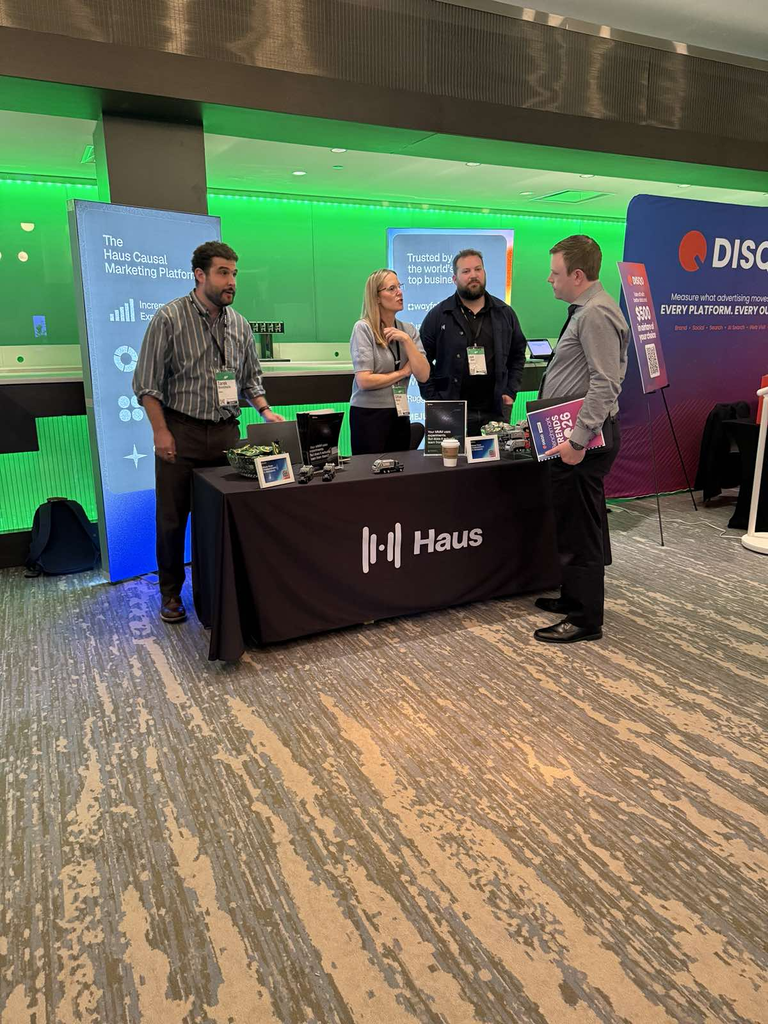
(Haus booth at the exhibition, representing the growing focus on experimentation and incrementality measurement.)
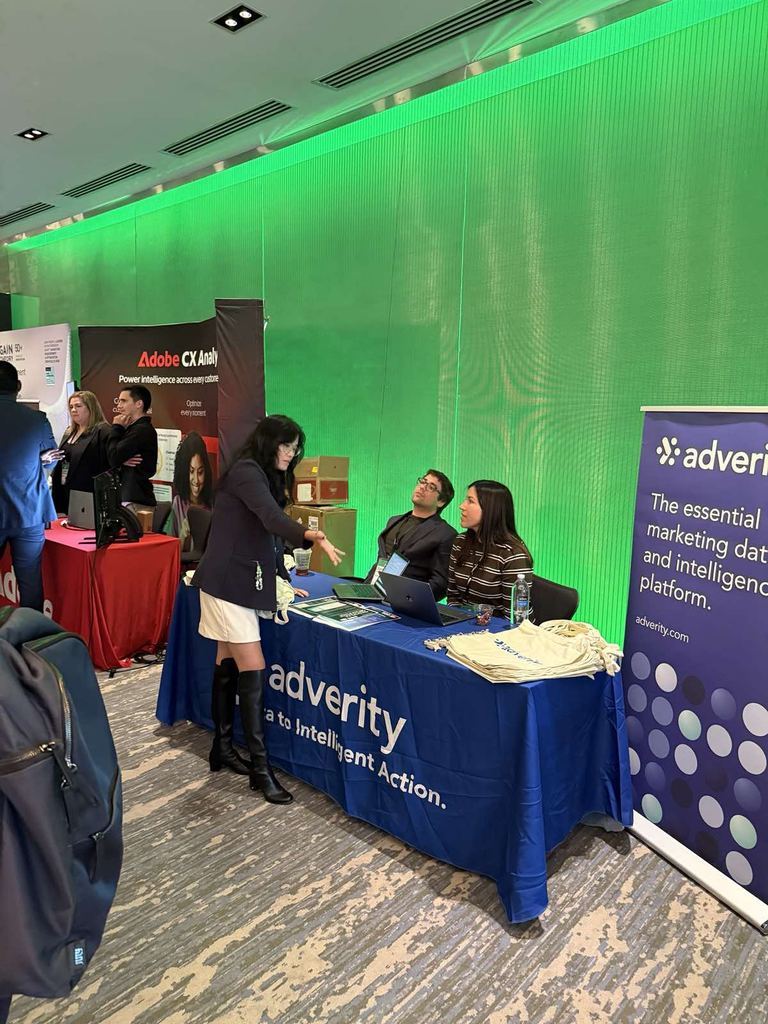
(Adverity booth at the exhibition, representing the data integration and marketing intelligence layer of the modern measurement stack.)
Closing: Is Your Measurement Foundation Ready for AI?
Across three days in Chicago, three messages stood out to me.
First, measurement is moving from reporting toward decision-making. Its role is increasingly to help organizations decide with confidence, not just to describe what happened.
Second, no single methodology or number can answer every marketing question. Attribution, experiments, incrementality, and MMM each answer different questions. The goal is not to find one perfect number, but to combine the right evidence for the decision at hand.
Third, AI makes trusted data, definitions, and measurement foundations more important, not less. As Lowe’s and CVS Health showed, AI accelerates whatever it is built on.
That raises a practical question for every marketing team: is your measurement foundation ready to support AI-driven decision-making? A few questions are worth asking:
- Are important website and app actions measured correctly?
- Are KPI and conversion definitions consistent across teams?
- Are first-party signals and consent managed properly?
- Can digital data connect to CRM and sales data?
- Is the data reliable enough to support experiments, MMM, and AI?
Web and app measurement is not the whole picture, but it is one practical foundation that many of these capabilities draw on. For many organizations, this is also where measurement becomes practical. At Ayudante, we support this foundation through Web and App measurement design, first-party data collection, consent management, data integration, and reporting, including GA4/GTM, server-side measurement, BigQuery, and BI. Our original solution, MATSUBA, strengthens this measurement foundation by helping organizations preserve trusted first-party signals and ownership of their measurement data.
The biggest lesson from Chicago was not that marketers need more dashboards or more AI. It was that faster decisions require more trusted evidence. I’m already looking forward to seeing how these ideas evolve by next year’s conference, which the ANA has confirmed will return to Chicago in 2027.

(Ayudante team members at the 2026 ANA Measurement & Analytics Conference in Chicago.)