

Spending More on Ads but Not Seeing Results? The Culprit May Be Hidden Gaps in Your Measurement
(This article is picked up from the October 2026 issue of Ayudante News, the newsletter of Ayudante in Japan. The original article in Japanese was written by Naho Kobayashi. This article was translated by Masaki Kuroshima.)
“We increased our ad budget from last year, but conversions aren’t growing the way we expected.”
“Year over year, our CPA keeps creeping up and our ROAS keeps slipping.”
We hear this a lot from teams running paid media.
Is it the economy? Softer demand? Less search traffic because of AI-powered zero-click search? More competition?
There’s no shortage of possible explanations. But because there’s no easy way to test any of them, many teams end up saying “let’s wait and see” without ever pinning down the cause.
In fact, part of the problem may not be the market at all, but your measurement. Your ads may be producing results that simply aren’t being counted. We call these “hidden gaps” in your data.
Neither Your Ad Platform nor GA4 Will Tell You How Much You’re Missing
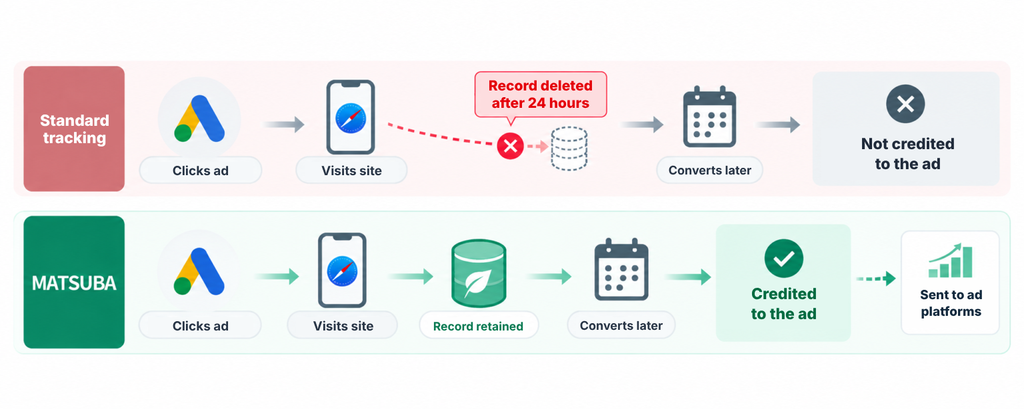
One major reason conversions go uncounted is the privacy protection built into iPhones and other devices. Say someone clicks your ad, visits your site, and converts a few days later. If the browser has already deleted the record showing that this person came from an ad, it becomes hard to attribute that conversion to the ad.
The tricky part is that neither your ad platform nor Google Analytics 4 (GA4) shows how large this gap is. Both have mechanisms to make up for data lost to privacy protections. But you can’t tell from the reports alone how much data your own business is actually losing.
You may have seen industry studies claiming that privacy protections wipe out some percentage of conversions. Whether that applies to your own ads, though, is something your existing reports can’t tell you. The most reliable way to find out is to set up a separate, more complete yardstick and compare the two side by side.
A More Complete Yardstick Reveals the Gap
That yardstick is MATSUBA, the “Data Ownership Engine” that Ayudante launched in Japan in June 2026.
On iPhones, the records that ad platform tags leave in the browser can be deleted after a short period. MATSUBA uses measurement infrastructure that runs on your own website’s domain, which is designed to reduce the impact of browser tracking restrictions. In some cases, it can retain click data much longer than conventional ad measurement, where that data is easily lost.
This means MATSUBA can connect the same person’s journey from ad click to conversion over a longer period. It can then check, user by user, whether the ad platform’s record still existed at the time of conversion.
In other words, you can see where and how much you’re under-counting, based on your own data rather than industry averages.
With conventional measurement, when an iPhone deletes the record, a conversion that happens days later is no longer linked to the ad. By retaining click information for a longer period, MATSUBA can help attribute conversions that occur days later to the original ad click.
Why Ad Click Data May Disappear After 24 Hours on iPhones
First, let’s look at where the gap occurs.
One cause is Intelligent Tracking Prevention (ITP), which Apple introduced in Safari in 2017. It was built to limit tracking of the same person across multiple sites, for example from the site where your ad appeared to your own website. Privacy protection is a core pillar of Apple’s products.
This restriction is applied automatically to iPhone users’ data, without them changing any settings. And Apple keeps tightening it.
The chart below shows data from one MATSUBA client from July to September 2026. It shows, by time from site visit to conversion, the percentage of conversions where the Google Ads click record was already gone at the time of conversion.
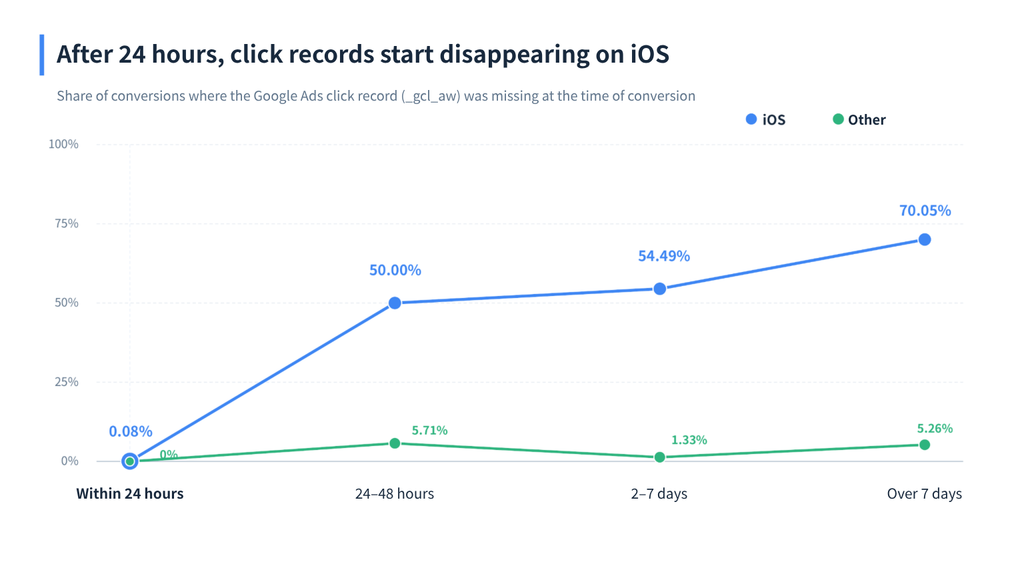
On iOS, Google Ads click records start disappearing sharply after about 24 hours. Under certain conditions, such as visits that include tracking parameters in the URL, ITP limits the lifespan of Cookies set by JavaScript to 24 hours. The change in the chart is consistent with this restriction. On non-iOS devices, the loss stays low.
As a result, the more time passes between the visit and the conversion, the more likely it is that the “came from an ad” information is gone. Compared with people who convert the same day, people who take several days to compare and evaluate are less likely to be counted as ad conversions.
This isn’t just a Safari issue. On iPhones, Chrome and in-app browsers (such as Instagram, the Google app, and LINE, a messaging app widely used in Japan) are affected in the same way.
Japan has a particularly high share of iPhone users. According to StatCounter, iOS accounted for about 60% (60.5%) of smartphone traffic in Japan in September 2026, compared with about 30% (30.8%) worldwide. That makes the share of affected iPhone users in Japan about twice the global average.
Translator’s note: North America is in a similar position. StatCounter puts iOS at 52.0% of mobile traffic in the United States (October 2026) and 64.9% in Canada (September 2026), well above the worldwide average.
The Gap Remains Even with Enhanced Conversions
So how many conversions is Google Ads actually missing?
Google Ads has its own ways to fill the gap. The best known is Enhanced Conversions. Enhanced Conversions uses hashed first-party customer data, such as email addresses, to help Google match conversions with signed-in Google users. That way, conversions can still be credited to ads even after the click record is gone. On top of that, conversion modeling estimates the conversions that couldn’t be matched. Many advertisers already have Enhanced Conversions in place.
Even so, a gap remains. In data from one MATSUBA client, MATSUBA recorded about 10 to 30% more conversions than the Google Ads interface. Part of this difference may be due to differences in how conversions are counted. However, in this case, a gap remained even after Google Ads’ conversion recovery mechanisms were taken into account.
(This is a single client example and does not guarantee similar results.)
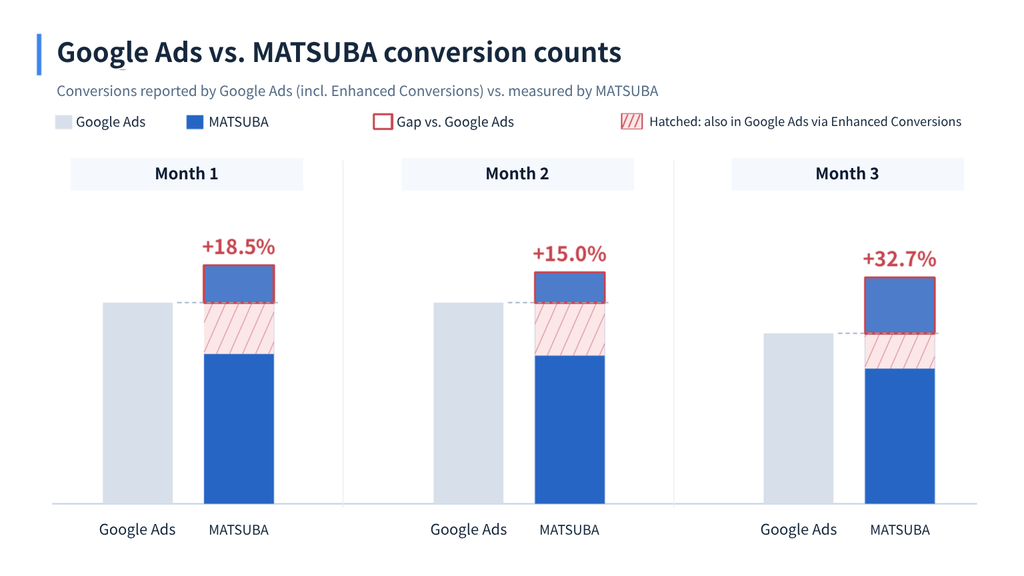
The key point is that this gap is what remains after Google’s recovery. The conversion count in Google Ads already includes conversions recovered through Enhanced Conversions and modeling.
The conversions reported in Google Ads are roughly shaped by these factors:
- Actual conversions (results genuinely driven by your ads)
- Minus conversions that went uncounted because records were deleted (for example, by iPhone restrictions)
- Plus the portion recovered through Enhanced Conversions and modeling
Even with that recovery included in Google Ads, MATSUBA recorded more conversions in this comparison. The difference may include conversion data that Google Ads wasn’t able to recover.
As we saw earlier, the more time passes after a site visit, the more likely the record is to disappear. The gap is likely to be even larger for products and services with long consideration cycles, such as real estate, education, and B2B services.
GA4 Shows the Same Gap
Many marketers tell us, “The numbers in the ad platform include estimates, so we double-check them in GA4.” But Google Ads and GA4 count conversions (key events) differently to begin with (see Google Ads Help, “Data discrepancies: Factors and troubleshooting”).
On top of that, GA4 also identifies users based on records stored in the browser, so it’s affected by iPhone restrictions in the same way.
On iPhones, GA4’s records are also deleted after a certain period. When the person returns, GA4 may identify them as a new user if no other identity signals are available.
- This can lead to an overestimation of unique users.
- The link to the earlier ad click is broken, so when that person returns and converts, the conversion is more likely to be credited to another traffic source instead of “google / cpc.”
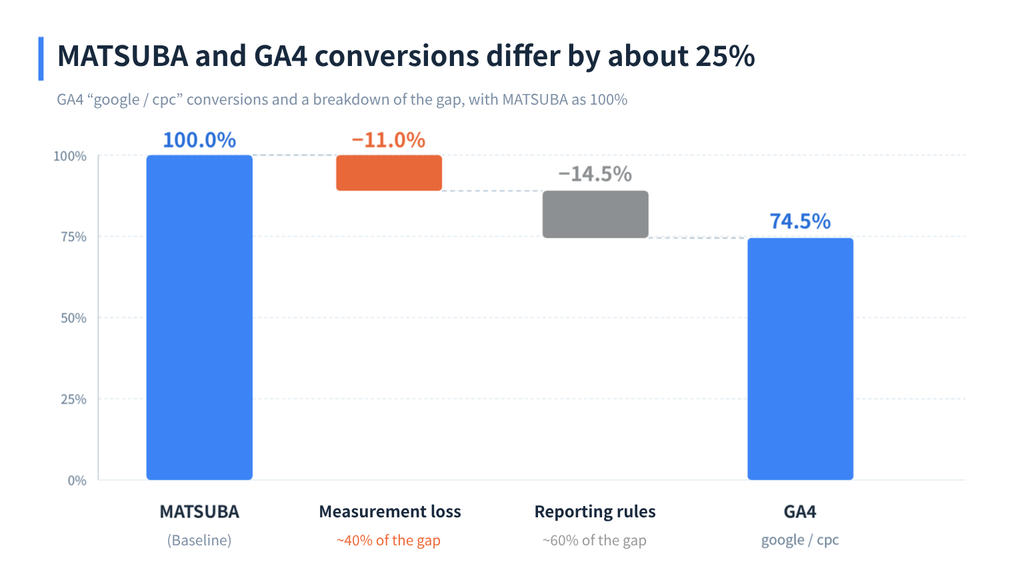
When we compared the two in a real MATSUBA implementation, GA4 reported about 25% fewer conversions (key events) for “google / cpc” than MATSUBA.
About 60% of this gap came from GA4’s reporting rules, which credit each conversion to the traffic source of the session in which it happened. The remaining 40% or so (about 10% of total conversions) was measurement loss: conversions GA4 couldn’t connect to the ad click.
The main cause is likely ITP resetting the Cookie-based user ID, among other factors. The takeaway: GA4 numbers need to be read with its reporting rules in mind.
AI That Learns from Incomplete Conversions Narrows Your Reach
The gaps we’ve covered are more than a reporting annoyance. In today’s paid media, they affect performance over the long term.
Most campaigns now run on AI-powered automated bidding. The AI learns “what kind of people convert, and in what situations,” then predicts when a conversion is likely and bids more aggressively in those moments. But if conversions from iPhone users, or from people who take time to decide, are missing from your data, the AI may learn that these people are unlikely to convert.
As a result, you may miss out on conversions you should be winning. Delivery to those audiences drops, and conversions drop with it. Fewer conversions skew the learning even further, creating a vicious cycle. This could be one reason why “we increased our budget but results didn’t grow.”
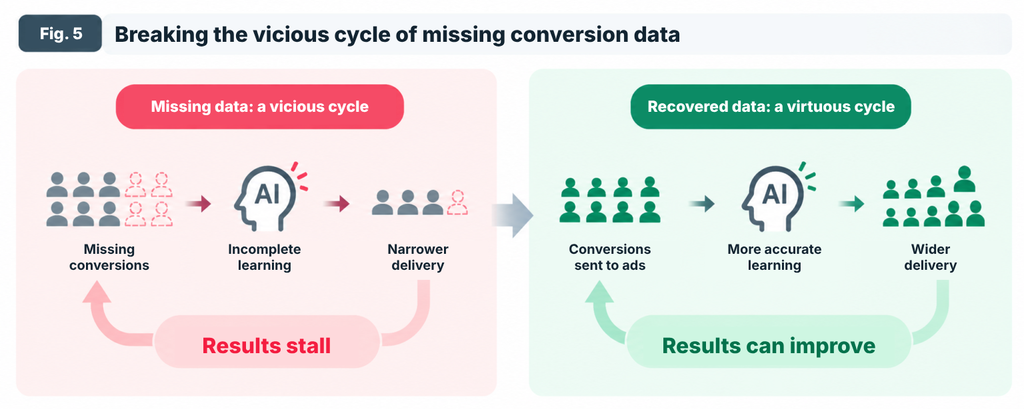
MATSUBA can send the conversions it measures back to ad platforms via API. It supports Google Ads, Meta Ads, Microsoft Advertising, X Ads, and LINE Yahoo (Japan’s major ad platform). When previously uncounted conversions reach the AI, it has more results to learn from, making it easier to win back the people who are most likely to convert.
In other words, MATSUBA doesn’t just find the gaps. It helps recover previously uncounted conversions and makes that data available to support future campaign optimization.
Answering “Why?” with Your Own Data
Until now, analyzing gaps and discrepancies took a lot of time and expertise. In the end, both advertisers and their agencies often had little choice but to take the numbers reported by ad platforms at face value.
MATSUBA is preparing a feature that connects your accumulated data to AI tools such as ChatGPT and Claude through MCP (Model Context Protocol). You’ll be able to analyze your own data just by asking questions like “How did iPhone data loss change last month?” or “How big is the measurement gap in the campaigns where CPA went up?” Beyond ads, you’ll be able to check traffic from social posts, email newsletters, and affiliates the same way.
We’ll share more about this AI analysis feature as soon as it’s ready.
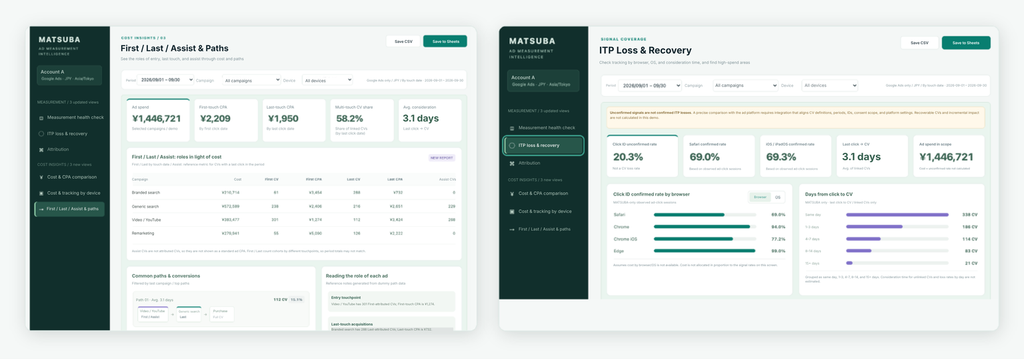
When your CPA goes up, is it a change in the market or a measurement gap? Until now, there was no way to tell, and teams had little choice but to work through trial and error without seeing the real cause.
With more complete measurement as your baseline, you can see where and how much your numbers are off, using your own data. Send that data back to your ad platforms, and automated bidding can relearn from more complete conversion data. In the near future, you’ll be able to run that analysis yourself, simply by asking AI.
Now that AI is essential to running ads, the data you feed the AI, and the ability to verify it, are things you want to keep in your own hands. Your data belongs to you, not to the ad platforms or your measurement vendors. That’s why we call MATSUBA a “Data Ownership Engine.”